
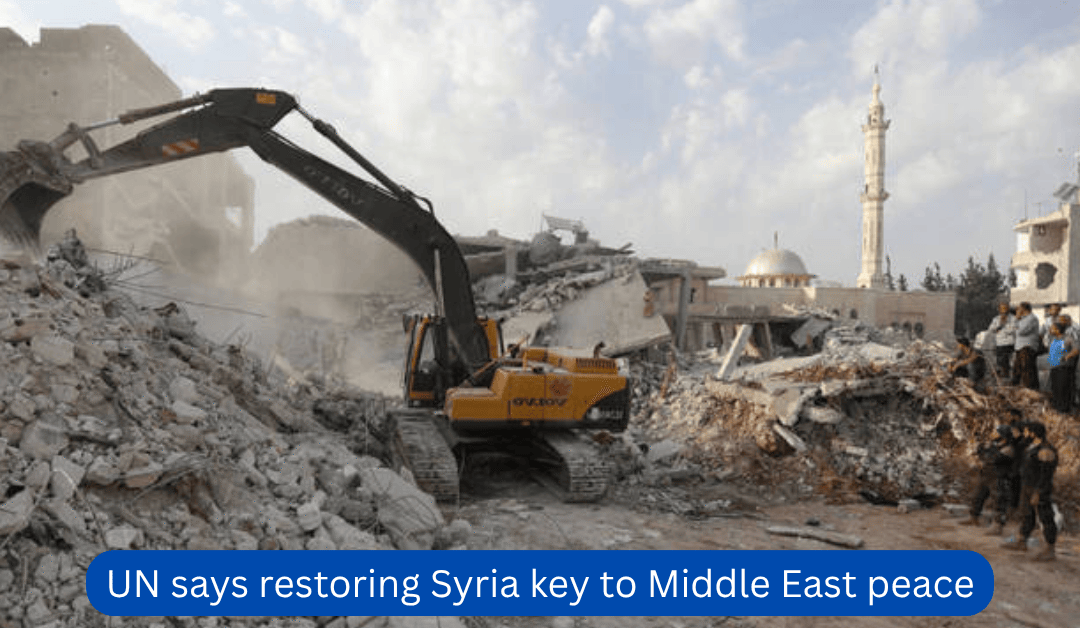
After 14 long years of destruction, Syria must be rebuilt quickly so the country and its wider region can find peace and stability. These are the words of a top UN official working in the war-torn nation.
A country ready for recovery
The international community now faces one of its biggest tests: how to help rebuild Syria. The country’s new authorities took over after the long-time leader Bashar Assad was removed in December last year. Reconstruction is now one of their biggest challenges.
“The international community should definitely rush into rebuilding Syria,” said Rawhi Afaghani, the deputy representative of the United Nations Development Programme in Syria. He made these remarks recently during a visit to Geneva.
He added: “Helping the country bounce back from this war and this destruction is good not just for Syrians themselves, but also for the stability and welfare of the whole region.”
This is very much about infrastructure investment and economic recovery. The official stressed that rebuilding homes, schools, hospitals, electricity and water systems is urgent.
The scale of the disaster
Since the civil war began in 2011 with the brutal government crackdown of protests, Syria has suffered greatly. More than half a million people have died and huge parts of the country’s infrastructure were destroyed.
According to estimates from the World Bank, the cost of rebuilding Syria’s damage could reach up to $216 billion.
Mr Afaghani did not put a precise figure on what is needed, but he described the needs as “massive”.
Here are some of those needs:
- Housing – many people have no homes or are living in damaged buildings.
- Schools and health centres – children and patients cannot access safe facilities.
- Utilities – water, electricity and sanitation services must be restored.
- Clean-up and removal of unexploded ordnance – war debris and bombs still litter many areas, blocking development.
He added that the vast quantities of unexploded bombs and mines make cleaning up the rubble harder, and create a long-term risk for people returning home.
Returns, pressure, and refugee return
More than one million Syrian refugees have returned from abroad, and almost twice as many internally displaced people have gone back to their home areas, according to UN data.
However, Mr Afaghani warned that these returns bring serious pressure: “People returning to destroyed houses or homes occupied by others,” he said.
He pointed out that the rebuilding delay puts the burden on local infrastructure:
- Transport networks are weak or broken.
- Schools and bakeries cannot keep up with rising demand.
- Many homes remain unfit for returning families.
He stressed that this strain could lead to community tensions, meaning conflicts between neighbours or groups might increase if infrastructure and services do not keep pace with the return of people. At the same time, many Syrians who perhaps could return from Europe are not doing so, because they see a lack of jobs, services and safe homes. Mr Afaghani said: “We thought there would be a much higher rate of return,” but the conditions are still too hard for many.
Rebuilding for regional stability and AI innovation
The quick rebuilding of Syria is not just about the country itself, but also about the regional stability of the broader Middle East. A stable Syria means reduced conflict, fewer refugees fleeing, and fewer threats that spill across borders.
Mr Afaghani expressed hope that fast reconstruction would bring back more skilled Syrians from Europe. He said these people “can rebuild Syria” and become a “big, good influence” in the region both economically and for peace-building.
In today’s world of AI innovation and fast global change, rebuilding the infrastructure in war-torn countries also opens doors for new technologies, investment and growth. By combining infrastructure work with smart technologies, Syria could leap ahead – but only if the world steps in.
Why it matters now
- Urgent action is needed. The longer reconstruction is delayed, the more entrenched the destruction becomes.
- Rebuilding helps with refugee return. Better services, homes and jobs bring people back, reducing humanitarian pressure on neighbouring countries.
- It supports economic recovery. Once homes, roads, schools and utilities are rebuilt, local economies can begin to grow again.
- It boosts regional stability. A functioning Syria reduces the risk of spill-over conflicts, refugee crises and instability in neighbouring states.
This is truly Latest News of global importance. Rebuilding Syria is a huge task, but also a vital one for the country and its region. The world must turn the page from war to peace, from destruction to construction, from crisis to growth. Only then can the dream of a stable, thriving Syria become a reality – and that would benefit all.


