
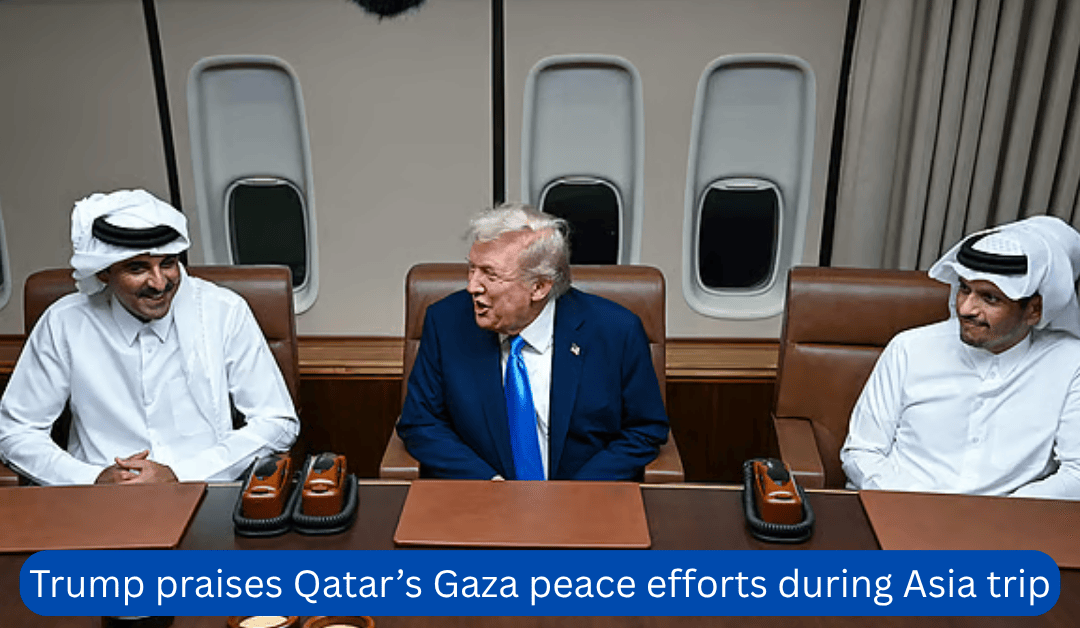
Aboard Air Force One, U.S. President Donald Trump expressed deep gratitude to Qatar’s Emir Sheikh Tamim bin Hamad Al Thani and Prime Minister Sheikh Mohammed bin Abdulrahman Al Thani for their important role in helping secure a Gaza ceasefire. The meeting took place during a brief refueling stop at Al Udeid Air Base in Qatar on Trump’s way to Asia.
Trump said the Qatari leaders had been “a big factor” in bringing peace to the Middle East, calling their efforts “incredible.” The air base is home to thousands of American troops and serves as the regional headquarters of the U.S. military.
Warm Welcome Aboard Air Force One
During the stop, Qatar’s Emir personally boarded Air Force One to meet President Trump. In a light moment shared online, the Emir joked, “I’m not going to let him take off unless I say hello.” The meeting was friendly but also deeply focused on maintaining peace in Gaza and strengthening diplomatic ties between the U.S. and Qatar.
Trump praised the Emir and Prime Minister for their consistent support in peace talks, saying,
“What we’ve done is incredible — peace in the Middle East — and they were a very big factor in it.”
U.S. Secretary of State Marco Rubio, who had just returned from Israel after a round of high-level meetings, was also present. His presence signaled how serious Washington is about keeping the fragile truce in Gaza stable.
Qatar’s Vital Role in the Gaza Truce
Qatar has emerged as a key peace mediator in indirect talks between Israel and Hamas since the conflict began in October 2023. Working alongside the United States, Egypt, and Turkey, Qatar has helped maintain communication channels between the warring sides.
Recently, Sheikh Tamim met with Turkish President Recep Tayyip Erdoğan to discuss the next stage of the Gaza deal. The two leaders reviewed steps toward forming a security force in Gaza and determining the future of Hamas’ leadership.

Sheikh Mohammed, Qatar’s Prime Minister, has also been central to the ongoing mediation. His efforts have earned praise from both Western and Middle Eastern leaders for helping to prevent further escalation in the region.
Trump’s Asia Mission
President Trump’s meeting with Qatar’s leadership came just hours before his first major trip to Asia since returning to office in January. His visit includes participation in two major regional summits and direct meetings with China’s President Xi Jinping and other key Asian leaders.
According to U.S. officials, one of Trump’s goals is to strengthen U.S.-Asia relations while ensuring stability in the Middle East. During his conversation with the Qatari leaders, Trump referred to the Emir as “one of the great rulers of the world” and described the Prime Minister as his “friend to the world.”
Qatar’s Emir later shared a message on X (formerly Twitter), expressing his pleasure in meeting Trump and discussing “plans for lasting peace in the Middle East” and the “strategic cooperation” between their two nations.
Tensions in Gaza Continue
Despite the peace deal, tensions remain high. Around the same time as Trump’s meeting, Israel launched an airstrike targeting a suspected Islamic Jihad militant in Gaza. Though Hamas and Israel agreed to a ceasefire, Israel insists on retaining the right to defend itself from any militant attacks.
Trump later posted on Truth Social, saying,
“Let’s see what they do over the next 48 hours. I am watching this very closely.”
His comment shows the U.S. is carefully monitoring the situation to ensure both sides respect the truce.
Looking Ahead
As Trump continues his Asia tour, his meeting with Qatar’s leaders highlights America’s growing reliance on Gulf nations for regional peace efforts. With Qatar acting as a diplomatic bridge between conflicting sides, the world is watching whether these peace efforts can truly bring long-term stability to Gaza and the Middle East.
This high-level interaction also shows that U.S. diplomacy under Trump 2.0 aims to balance global engagement — from the Middle East to Asia — while promoting peace and economic cooperation.


