
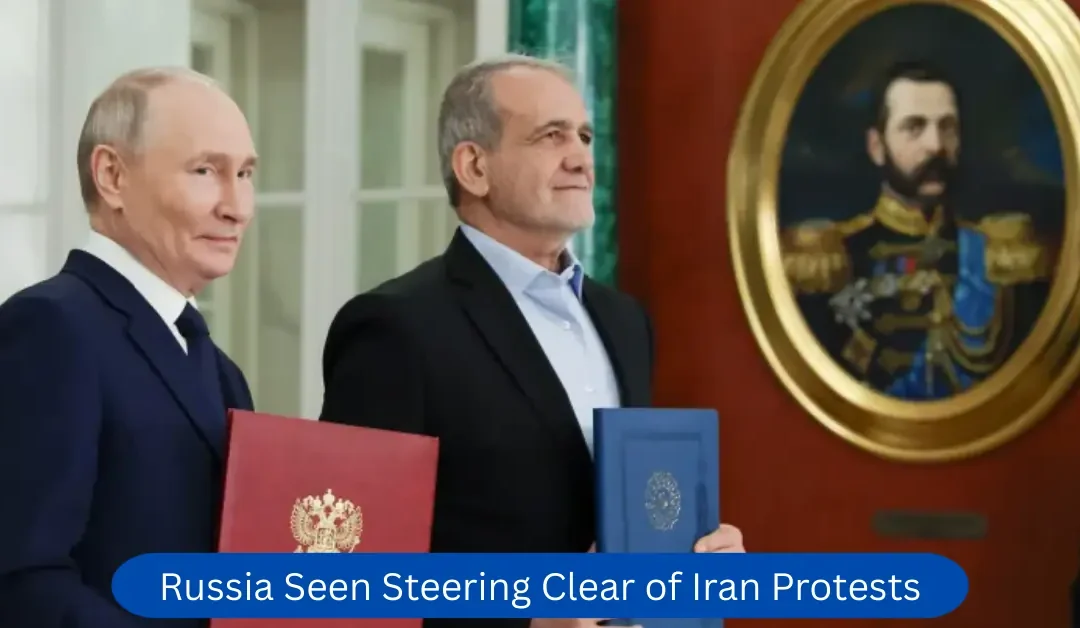
In the Latest News from the Middle East, large protests in Iran have drawn global attention, but Russia is not expected to take any direct action to support Tehran. Analysts say Moscow wants to avoid another political embarrassment and does not see the unrest as a serious threat to Iran’s leadership.
The protests began on December 28 after anger over rising prices, unemployment, and economic pressure caused by international sanctions. Within days, demonstrations spread to hundreds of cities and towns across Iran, a country of more than 90 million people. This wave of unrest has since become part of Breaking News and Daily news highlights worldwide.
Protests and Crackdown Inside Iran
Iranian security forces moved quickly to stop the protests. According to reports, police and other forces used strong measures, and possibly violence, to break up demonstrations. Internet access was also shut down for several days, making it difficult to confirm what was happening on the ground.
Iranian state media said more than 100 security personnel were killed during the unrest. Opposition groups, however, claim that the number of dead protesters is much higher, possibly in the thousands. These figures cannot be independently verified due to limited access and communication blocks.
Despite the protests, many experts believe Iran’s government is still firmly in control.
Russia Says West Is to Blame
Russia’s Foreign Ministry strongly blamed Western countries for the unrest. On Tuesday, it condemned what it called “illegal Western pressure” and accused unnamed foreign forces of trying to weaken and destroy Iran.
Foreign Ministry spokeswoman Mariya Zakharova said the protests followed the pattern of so-called “colour revolutions.” She claimed that trained outsiders turn peaceful protests into violent chaos, leading to deaths and destruction.
This language has been used by the Kremlin for many years to describe uprisings in countries like Ukraine, Georgia, and Kyrgyzstan. Russia often says such movements are planned and funded by Western governments.
Zakharova also criticized US President Donald Trump, calling his comments about helping Iranian protesters “completely unacceptable.”
Trump’s Statements Add Tension
President Trump openly supported the protesters. He urged Iranians to take control of institutions and claimed that US help was coming. In recent months, he has also used strong language against Iran’s leadership, even calling Supreme Leader Ayatollah Ali Khamenei an “easy target.”
These remarks increased tensions but did not lead to any direct action. Russian officials responded with words, not threats, showing that Moscow is careful about how far it goes.
Why Russia Is Staying Silent
Russian President Vladimir Putin has not commented publicly on the protests. Analysts say this silence is intentional.
According to political observers, Moscow waited to see whether Iran’s government would survive. Speaking too strongly could have damaged Russia’s chances of working with any new leadership if the situation changed.
This cautious approach is similar to Russia’s reaction to events in Syria in the past, where Moscow avoided bold moves until the political future became clearer.
Long and Complicated Russia–Iran Ties
Russia and Iran have a long and complex relationship. In the past, Russian rulers took large areas of Iranian land. During the Soviet era, Moscow tried to increase its influence in northern Iran and its oil industry.
In recent decades, however, the two countries became close partners. Russia helped Iran avoid harsh UN sanctions, built the Bushehr nuclear power plant, and supplied advanced weapons, including air defence systems.
In return, Iran supported Russia during the Ukraine war by providing drones, ammunition, and other military equipment. This partnership has been important for both sides, especially as they face heavy Western sanctions.

No Appetite for Military Risk
Even with this close relationship, experts say Russia will not risk direct involvement in Iran’s unrest. Former Russian diplomat Boris Bondarev said Moscow has nothing to gain and much to lose.
Russia is already struggling with sanctions, economic pressure, and public fatigue from the Ukraine conflict. Many Russians are focused on daily survival, rising prices, and job security rather than foreign crises.
Bondarev said challenging the US over Iran could damage Russia’s position in ongoing talks related to Ukraine.
Voices From the Ground
Ordinary Russians appear largely uninterested in Iran’s problems. One mother from the Russian city of Yekaterinburg said her family is worried about everyday issues like mortgage payments, blocked online games, and low salaries.
Her words reflect a broader feeling that foreign policy concerns matter less than domestic struggles.
What Happens Next?
Some pro-Kremlin analysts believe Iran will suppress the protests but still need reforms. One analyst suggested Russia could help Iran by sharing advice on political and economic reforms once the unrest ends.
For now, however, Russia seems content to watch from the sidelines. Its leaders believe Iran’s government is stable enough and that stepping in could harm Russia’s global image.


