
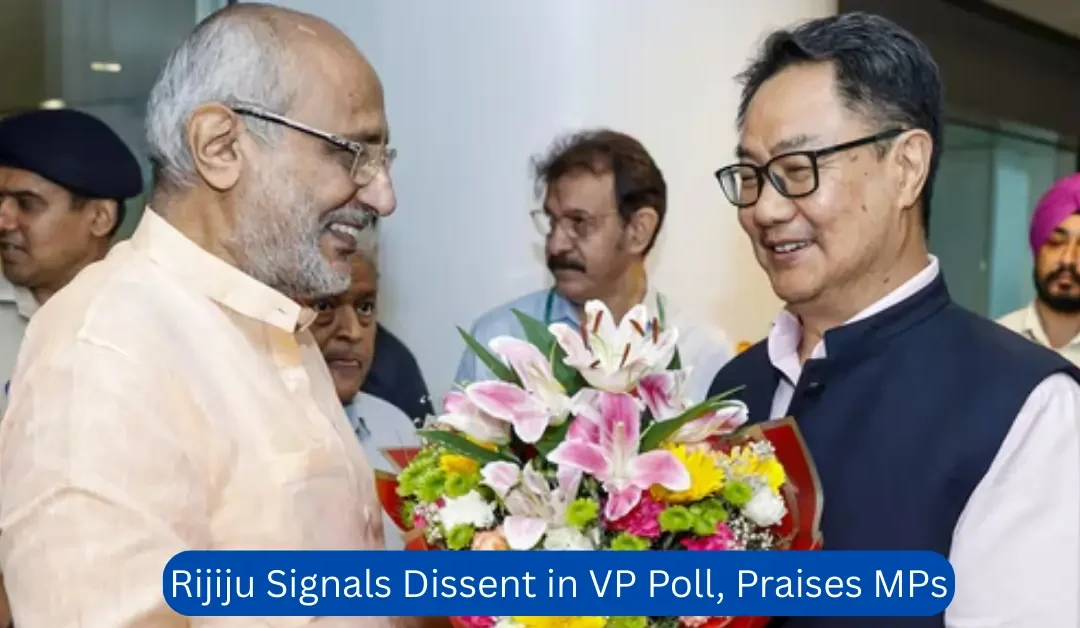
In the Latest News from New Delhi, the vice-presidential election in India has brought unexpected reactions from both the ruling party and the opposition. On Tuesday, September 9, NDA candidate CP Radhakrishnan was elected as the Vice President of India after securing 452 votes out of the 767 polled. His victory came through a secret ballot election held in Parliament.
This result was not just about numbers but also about possible cross-voting from the INDIA bloc MPs, which gave the ruling alliance a stronger margin of victory.
Rijiju Thanks Opposition MPs
Union Parliamentary Affairs Minister Kiren Rijiju made headlines when he publicly thanked certain INDIA bloc MPs for allegedly voting in favor of the NDA’s candidate.
- Rijiju posted on X (formerly Twitter) to express gratitude toward opposition lawmakers who, according to him, voted “with conscience.”
- He congratulated CP Radhakrishnan and described him as a “humble, efficient, and true patriot.”
- Rijiju emphasized that the NDA and its friendly MPs remain united, highlighting that the win shows political strength and support across party lines.
- His remarks have sparked fresh discussions about loyalty, conscience, and party discipline in Indian politics.
This Breaking News not only reflects the outcome of the election but also underlines the growing cracks within the INDIA bloc, which had expected to stay united during the vote.
Election Process: Secret Ballot and Conscience Voting
The vice-presidential election in India was conducted through a secret ballot system, where MPs cast their votes privately.
- Representatives from both the NDA and the INDIA bloc were present during the voting process.
- Ballots were counted in the presence of officials from both political sides, ensuring transparency.
- Rijiju said that “no one can steal the heart and mind of MPs,” stressing that the vote was purely based on conscience and free choice.
- The outcome shows how individual MPs may sometimes put conscience above party lines, especially in crucial elections.
This has raised an important debate in Parliament news circles about whether cross-voting is an act of betrayal or a sign of true democracy.
CP Radhakrishnan: India’s New Vice President
The victory of CP Radhakrishnan is significant for several reasons:
- He received 452 votes, a clear majority out of the total 767.
- His election is seen as a strong endorsement of the NDA’s leadership in Parliament.
- Leaders from the ruling alliance described him as a man of integrity who will bring humility and efficiency to the vice-presidential office.
- Political experts believe his role will be important in ensuring smooth coordination in Parliament sessions.
This political update marks the beginning of a new chapter in India’s parliamentary history, as Radhakrishnan takes on responsibilities that directly impact the functioning of both houses of Parliament.
Cross-Voting Sparks Political Buzz
The most discussed part of the election has been the possibility of cross-voting. Reports suggest that a section of opposition MPs may have supported the NDA candidate, weakening the position of the INDIA bloc.
- Some political analysts say this shows internal disagreements within the opposition.
- Others argue it reflects MPs choosing conscience over party orders.
- For the ruling NDA, this has become an opportunity to showcase political unity and strength.
- The INDIA bloc, on the other hand, may now face questions about trust, loyalty, and internal discipline.
The buzz around cross-voting has turned this election from a routine process into a Breaking News story with nationwide attention.
What This Means for Indian Politics
The election of CP Radhakrishnan as Vice President is more than just a change of office—it reflects deeper shifts in Indian politics.
- For the NDA, it is a clear victory and proof of its expanding influence in Parliament.
- For the INDIA bloc, it is a warning sign that unity must be strengthened if it hopes to challenge the ruling alliance in future elections.
- For Indian democracy, it raises fresh debates about conscience voting, party loyalty, and the role of MPs in secret ballots.
As the story continues to unfold, one thing is certain: the vice-presidential election has added new energy and discussion to Indian politics. This moment, highlighted in today’s Daily news highlights, will likely influence both alliances as they prepare for the challenges ahead.


