
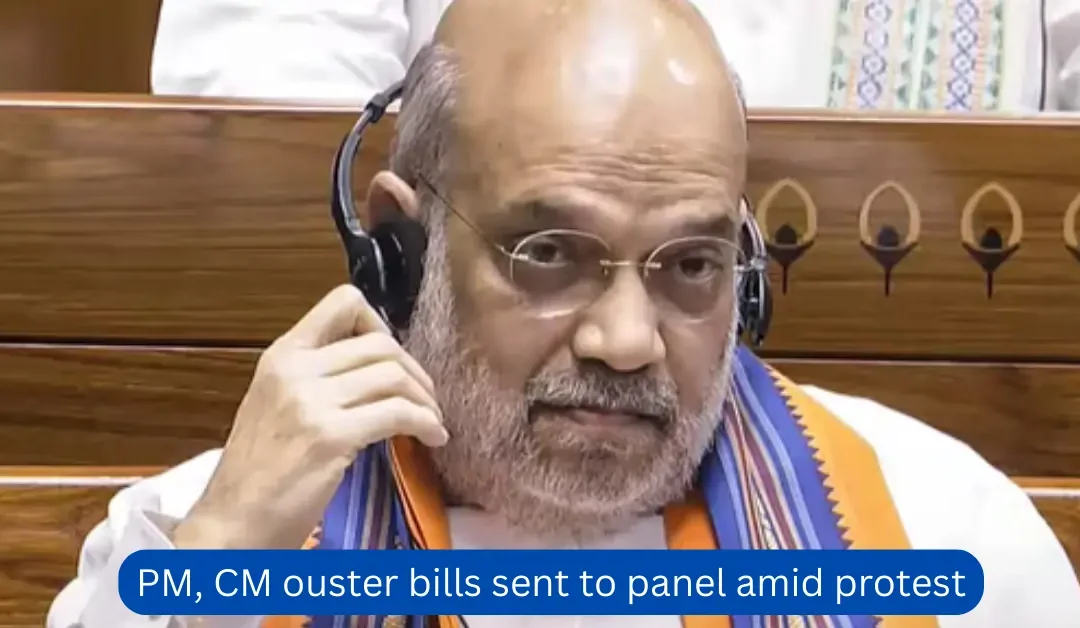
Big Political Move in Parliament
Latest News from New Delhi: The BJP-led NDA government has taken a bold step by sending three controversial bills to a Joint Parliamentary Committee (JPC). These bills say that if the Prime Minister, a Chief Minister, or any minister in a state or Union Territory is arrested for more than 30 days under charges that carry at least five years of jail term, they can be removed from office.
What makes this move even more debated is that the action can be taken even when there is no final court judgment—only allegations. The Opposition has strongly objected, saying this is against the spirit of the Constitution and could be used for political targeting.
What the Three Bills Are About
The three bills introduced are:
- The Constitution (One Hundred and Thirtieth Amendment) Bill
- The Government of Union Territories (Amendment) Bill, 2025
- The Jammu and Kashmir Reorganisation (Amendment) Bill, 2025
Union Home Minister Amit Shah defended the bills, calling them part of a bigger fight against corruption. He said politicians must not get special protection if they face serious charges.
Why this matters in Daily news highlights:
- The bills challenge the principle of “innocent until proven guilty.”
- They could change how political accountability works in India.
- They have already triggered heated debates in Parliament.
Just as people follow updates on Online Gaming bill or even search for lighter things like a Mango Pickle recipe, this legislation has quickly become one of the top searches in political news.
What Happens Next: Role of the JPC
The government has agreed to send these bills to a Joint Parliamentary Committee, which will include 21 members from Lok Sabha and 10 from Rajya Sabha, representing both the ruling and opposition parties.
Key points about the JPC process:
- The committee will study the bills in detail.
- It can invite experts, civil groups, and other stakeholders to share opinions.
- The committee’s report is not binding—the government can choose to accept or reject it.
- The report deadline is by the first week of the next session, likely in late November 2025.
This means the final decision has been pushed forward by about three months. Until then, debates will continue both inside and outside Parliament.
Opposition Protests and Concerns
As soon as Amit Shah mentioned the first bill, the Opposition began protesting loudly.
- Asaduddin Owaisi (AIMIM) said these bills are meant to “destabilise governments.”
- Manish Tewari (Congress) argued that treating people as guilty before trial goes against natural justice. He said it:
- Breaks the principle of “innocent until proven guilty.”
- Weakens parliamentary democracy.
- Creates space for political misuse.
These arguments remind many of recent cases where Chief Ministers like Arvind Kejriwal (Delhi) and Hemant Soren (Jharkhand) spent weeks in jail under corruption allegations. Both leaders said they were unfairly targeted using central agencies like the CBI and ED.
Opposition leaders fear that with such laws, governments could be brought down simply by arresting their leaders for a few weeks.
Key Takeaways for the Public
This development is one of the Daily news highlights in Indian politics. To understand it better, here’s a simple breakdown:
- What’s happening: Bills allow removal of PM, CMs, and ministers if arrested beyond 30 days on serious charges.
- What’s next: A Parliamentary committee will study the bills and give its report by late November.
- Why it matters: Opposition says it violates constitutional safeguards and can be misused.
- Public impact: Could change how democracy and accountability work in India.
Just like earthquakes today can shake the ground suddenly, these bills could shake up India’s political system in unexpected ways. And just as Mumbai rains often disrupt daily life, this move has already caused a storm in Parliament. Unlike a fun game of dream11, the outcome here will have real consequences for the nation’s future.


