
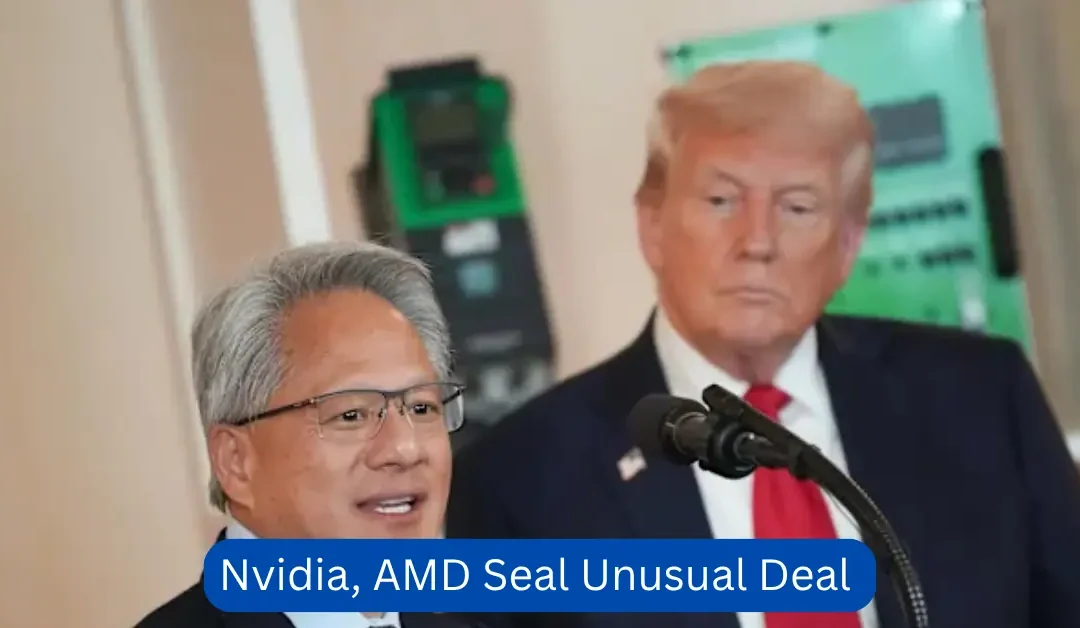
Two of the biggest names in the semiconductor industry, Nvidia and AMD, have reached an unusual deal with the US government. According to reports, the companies will now give 15% of the money they make from selling certain AI technology chips to China directly to the US government.
This agreement comes under the Trump administration’s tough tariff and export control policies, which have already reshaped global trade in technology. The move adds a new twist – instead of just restricting sales, the US government is now earning money from them.
Why This Deal Is Big News
- Nvidia and AMD are leaders in AI technology, especially in producing advanced chips for artificial intelligence and machine learning.
- The chips involved – Nvidia’s H20 AI accelerator and AMD’s MI308 chip – are already on a list of items with export controls due to US concerns about technology competition with China.
- This deal effectively makes the US government a “partner” in these companies’ China sales.
A spokesperson for Nvidia told Yahoo Finance:
“We follow the rules the US government sets for our participation in worldwide markets. We haven’t shipped the H20 chip to China for months, but we hope export control rules will still let America compete globally. America cannot repeat the 5G mistake and lose tech leadership.”
How the Agreement Happened
According to The New York Times, Nvidia CEO Jensen Huang discussed the deal with President Trump in a meeting last Wednesday. By Friday, the government had approved licenses for chip sales to China under the new 15% revenue-sharing condition.
For AMD, the terms are the same: the company must also pay 15% of its earnings from MI308 chip sales in China.
Stephen Olson, a former US trade negotiator, told Bloomberg:
“To call this unusual is an understatement. This is basically the monetization of US trade policy. If companies have to pay the government to export, we’ve entered a dangerous new territory.”
The China Tariffs Connection
This deal is part of a larger trade standoff between the US and China. The Trump administration has been using China tariffs to pressure Beijing on trade, technology, and agriculture.
Just this Sunday, Trump told China to quadruple its soybean purchases from the US before an August 12 deadline. If no agreement is reached, a pause on certain tariffs will end, and higher rates will apply to Chinese goods entering the US.
Key Takeaways From This Story
- 15% Revenue Share – Nvidia and AMD will give a portion of their China AI chip sales earnings directly to the US government.
- Export Control Chips – The affected products are Nvidia’s H20 and AMD’s MI308, both high-performance AI chips.
- Trade Policy Shift – Experts call it a new kind of tariff, where payment is made to export rather than just facing import duties.
- Bigger Trade Picture – This comes as the US pushes China on both technology and agricultural trade.
Why This Matters for Tech and Global Trade
The semiconductor industry is already at the center of the US-China rivalry. These chips are essential for AI research, supercomputers, and advanced data centers. Limiting – or monetizing – their sales could slow China’s AI development, while also increasing US government revenue.
However, there are concerns:
- Could this model spread to other industries?
- Will China retaliate with its own restrictions or tariffs?
- How will this affect global AI research and competition?
For now, Nvidia and AMD appear willing to accept the deal to keep selling in China, one of the biggest markets for AI chips. But as the August 12 tariff deadline approaches, tensions in global trade could rise again.
This is a developing story, and we’ll bring you more updates as they come in. Stay tuned for more Latest News and tech news coverage on this and other global economic developments.


