
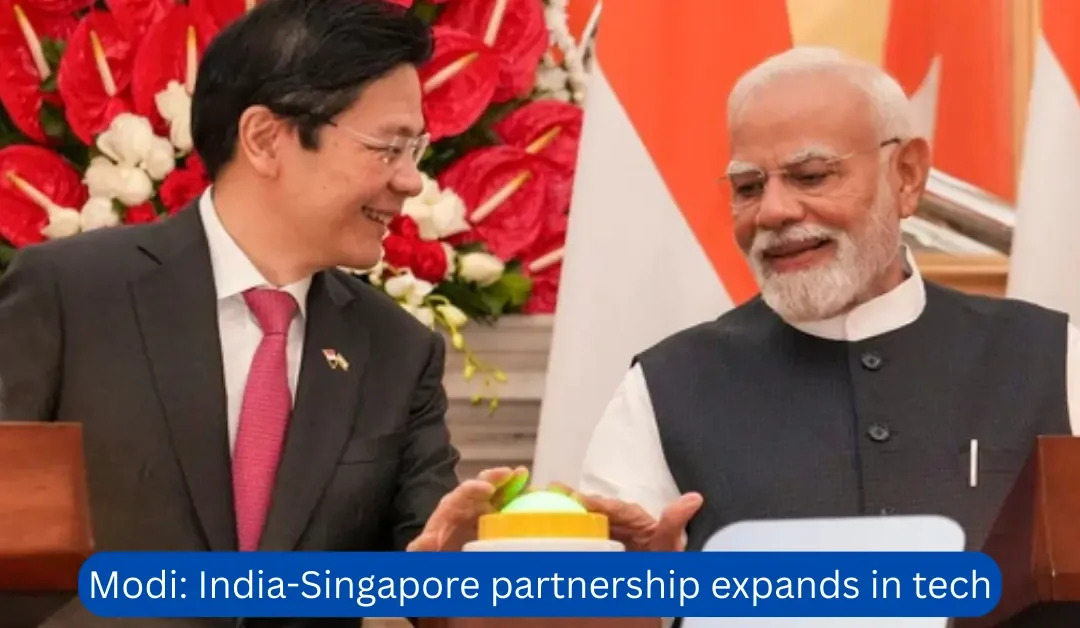
In the Latest News, Prime Minister Narendra Modi praised Singapore as a “strong pillar of India’s Act East Policy” during his meeting with Singaporean Prime Minister Lawrence Wong. He highlighted the growing cooperation between the two countries, especially in the fields of artificial intelligence (AI) and semiconductors. PM Modi said that relations between India and Singapore “go far beyond diplomacy” and reflect a deep partnership based on technology, innovation, and shared concerns for peace and stability.
The meeting between the two leaders comes at a time when India is pushing hard to expand its trade relationships in Asia, particularly after the United States increased tariffs on some Indian imports.
Stronger Ties in Technology and Innovation
- PM Modi emphasized that technology and innovation are the backbone of the India-Singapore relationship.
- Both countries agreed to work closely on AI research and semiconductor production, which are seen as crucial for the future of global industries.
- Singapore is already a leading global hub, producing nearly 10% of the world’s chips and 20% of semiconductor equipment. This makes the country a perfect partner for India, which aims to produce its first made-in-India semiconductors by the end of this year.
- The partnership is not only about trade but also about building long-term trust and expertise between the two countries.
New Agreements Signed
During the joint meeting, India and Singapore signed several agreements in different sectors:
- Shipping and civil aviation: These agreements will improve connectivity and trade logistics between the two nations.
- Emerging technologies: Cooperation will cover areas like digital economy, AI, and advanced chip-making technologies.
- Skill development: Singapore will help establish state-level skill centers in India, focusing on aviation and semiconductor industries.
Prime Minister Modi also mentioned the National Centre of Excellence for Skilling in Chennai, supported by Singapore, which will help prepare Indian workers for high-tech jobs in manufacturing.
Trade and Economic Partnerships
In the Breaking News section of the joint statement, Modi explained that both sides have agreed to review their Comprehensive Economic Cooperation Agreement (CECA) and India’s Free Trade Agreement (FTA) with ASEAN. The review will be done within a set timeframe to speed up mutual trade.
This decision is particularly important because India faces challenges from recent U.S. tariffs that doubled duties on Indian imports. Strengthening ties with Singapore and other Asian nations is expected to balance these economic pressures.
Singapore’s Prime Minister Wong said these agreements will “generate new growth opportunities” for both countries. He also highlighted Singaporean companies’ active participation in Semicon India, a major event for the semiconductor industry.
Beyond Trade: Cultural and Regional Cooperation
PM Modi underlined that India and Singapore’s relationship goes beyond business. Both countries share concerns about terrorism and have committed to fighting it together. He thanked Singapore for expressing sympathy after the April 22 Pahalgam terror attack in Jammu and Kashmir.
- Modi also highlighted the role of Indian states in building deeper ties with Singapore. For example, Gujarat’s GIFT City is helping connect stock markets in both nations.
- Singapore’s President Tharman Shanmugaratnam recently visited Odisha, strengthening cultural and economic links at the state level.
- Singapore’s ethnic Indian community also plays a key role in maintaining strong cultural and business connections.
PM Modi further said that India and Singapore will continue to work with ASEAN countries to promote peace and stability in the Indo-Pacific region. This shows that the partnership is not only about trade and technology but also about regional security and diplomacy.
A Future-Oriented Relationship
The Daily news highlights show that India-Singapore trade reached $34.26 billion in 2024–25. With new agreements and expanding cooperation in AI and semiconductors, this number is expected to grow further.
The visit of Singapore’s Prime Minister Wong follows that of German foreign minister Johann Wadephul, who expressed optimism about an EU-India free trade agreement being finalized soon. This signals that India is building a strong global network to strengthen its economy and technology sector.
What This Means:
- India and Singapore are deepening ties in AI and semiconductors.
- Multiple new agreements were signed in trade, aviation, shipping, and skills.
- Both nations aim to boost trade while tackling global challenges like terrorism.
- The partnership also supports India’s larger Act East Policy and Indo-Pacific vision.
This growing relationship shows that both nations are preparing for the future together, building strength not only in trade but also in shared values and security.


