
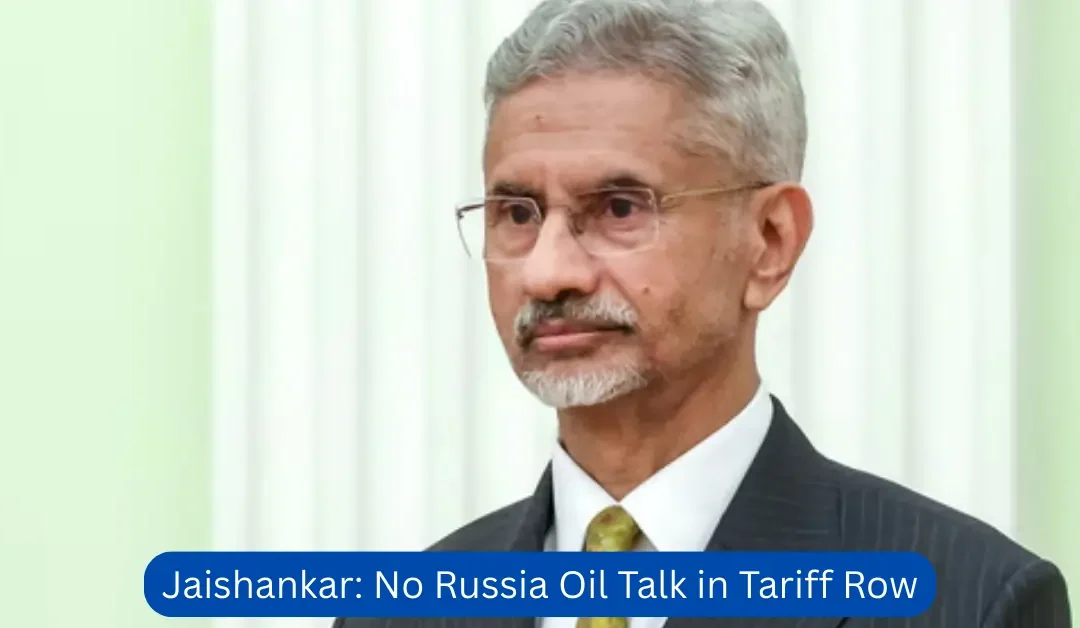
India’s External Affairs Minister S. Jaishankar has spoken out about U.S. President Donald Trump’s decision to raise tariffs on India to 50 percent. Speaking at the Economic Times World Leaders Forum 2025, Jaishankar explained that Trump’s style of conducting foreign policy is very different from past American leaders, and sometimes it leaves partners surprised.
According to Jaishankar, the issue of India buying Russian oil was never directly discussed with Washington before the tariff announcement. This makes Trump’s move unusual and concerning for India.
Jaishankar on Trump’s unique style
Jaishankar pointed out that Trump’s way of handling foreign affairs is very public, unlike any U.S. president before him.
- Public foreign policy: “We’ve not had a U.S. President who conducts foreign policy so openly,” he said. This, he noted, is not limited to India but applies to all of America’s global relationships.
- Domestic matters too: He added that Trump even handles his internal U.S. issues in the same way, making his approach very different from the traditional style of American politics.
- Tariffs as tools: The minister observed that Trump often uses tariffs not just for trade disputes but also for non-trade matters, which is new for global diplomacy.
Three key issues Jaishankar highlighted
Jaishankar broke down the situation into three important issues that India faces in relation to Trump’s policies:
- Trade disputes:
- Negotiations between India and the U.S. are still going on, he said.
- However, India has “red lines” to protect its farmers and small producers.
- Jaishankar clarified that talks have not broken down completely, but tensions remain.
- Oil purchases from Russia:
- Jaishankar said India is being unfairly targeted over its imports of Russian oil.
- He pointed out that other big buyers like China and the European Union are not facing the same criticism.
- The minister reminded that the Biden administration was already aware of India’s oil imports from Russia, and that conversations about a price cap had been held earlier.
- Mediation with Pakistan:
- Jaishankar firmly stated that India does not accept any external mediation in its issues with Pakistan.
- He made it clear that matters relating to India’s neighborhood must be solved directly by India without interference.
Wider global implications
The minister warned that the Trump administration’s approach could have global consequences:
- First announcements in public: Many times, the U.S. government announces a policy in public before officially informing the affected country. This creates confusion and disrupts trust.
- Unpredictability for allies: India, like many other U.S. partners, is trying to adjust to Trump’s unpredictable way of mixing trade, foreign policy, and domestic politics.
Why this matters for India
India is currently balancing its relationships with major powers, including the U.S., Russia, and China. Trump’s sudden tariff increase is not just about trade—it could also affect:
- India’s exports and small producers who rely on the U.S. market.
- Energy security, since oil imports are critical for India’s economy.
- Diplomatic ties, as India wants to strengthen its partnership with Washington while maintaining strategic independence.
Jaishankar’s remarks underline that India will continue talks but will stand firm on protecting national interests.
Final words
This episode reflects the changing face of global politics, where Breaking News can directly shape trade, energy, and security. For India, the challenge is to navigate these shifts without compromising its own priorities.
As Jaishankar noted, India’s position remains clear:
- Protect its farmers and small producers.
- Continue buying oil based on its energy needs.
- Reject any outside role in sensitive issues like Pakistan.
This statement adds another chapter to the Daily news highlights of U.S.-India relations, showing how diplomacy today is being reshaped in real time, often in front of the world’s cameras.


