
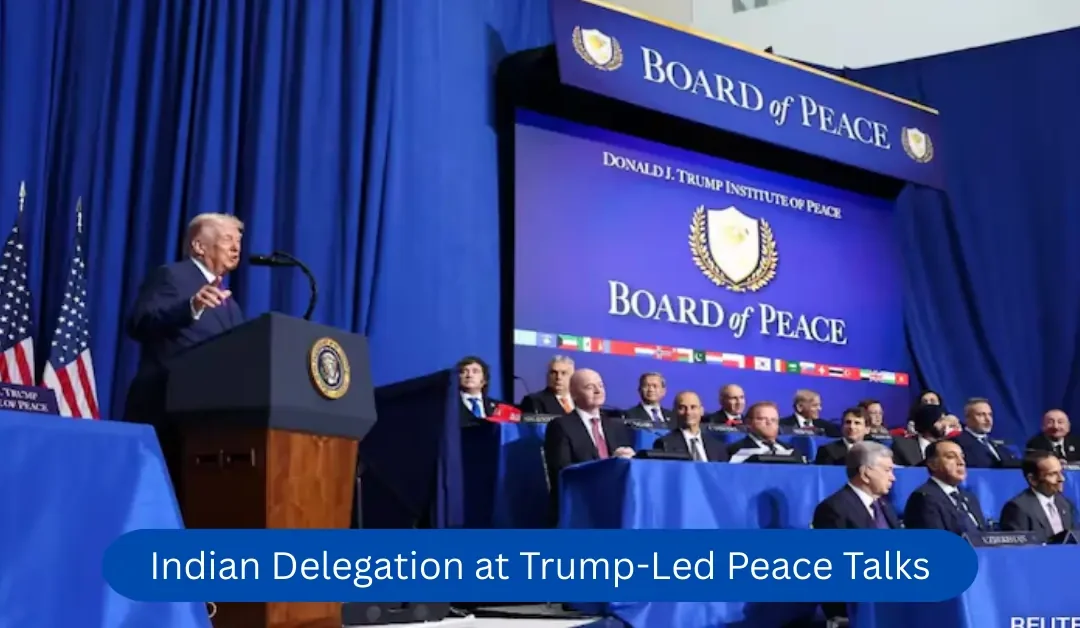
In the Latest News from Washington DC, India has attended the first official meeting of US President Donald Trump’s newly created Board of Peace. India joined the meeting as an observer country and was represented by Namgya C Khampa, who is currently serving as Charge d’Affaires at the Indian Embassy in Washington.
This move comes just one week after India’s Ministry of External Affairs (MEA) said it was still reviewing the invitation sent by the United States to join the new global body.
This development has become one of the major Daily news highlights, as many countries are closely watching how this new organisation may shape global peace efforts.
What Is Trump’s Board of Peace?
President Trump first introduced the idea of the Board of Peace during the annual meeting of the World Economic Forum in Davos last month. At that time, he said that many countries were interested in becoming part of this new body. He even suggested that it could one day become as influential as the United Nations.
Initially, the Board was planned to:
- Monitor the ceasefire between Israel and Hamas in Gaza
- Help rebuild Gaza after months of conflict
- Support governance and stability in the region
However, since its announcement, the vision for the Board seems to have grown much bigger. President Trump has hinted that the organisation could play a larger global role in maintaining peace.
India’s Careful Approach
India has taken a balanced and cautious stand on this issue. After receiving the invitation, the Indian government did not immediately accept or reject it. It also did not attend the launch event in Davos.
On February 12, MEA spokesperson Randhir Jaiswal said that the proposal was still under review. He clearly stated that India supports all efforts that promote peace in West Asia, including Gaza.
India’s Prime Minister has also spoken in favour of long-term peace in the region. However, instead of becoming a full member right away, India chose to attend the first meeting as an observer.
This shows that:
- India wants to stay informed about the Board’s plans
- India is open to engagement but not in a hurry to commit
- India is carefully studying how this body may function in the future
In today’s Breaking News environment, such diplomatic caution is seen as a smart strategy.
Who Attended the Meeting?
The first official meeting of the Board of Peace was held at the US Institute of Peace in Washington. Officials from nearly 50 countries took part.
Out of these:
- 27 countries are full members of the Board
- The remaining countries, including India and the European Union, joined as observers
Some of the full member countries include Azerbaijan, Belarus, Egypt, Hungary, Indonesia, Israel, Jordan, Morocco, Pakistan, Qatar, Saudi Arabia, Turkey, UAE, Uzbekistan, and Vietnam.
This wide participation shows that many nations are interested in exploring this new peace platform.

Major Announcements at the Meeting
The meeting included several big announcements that quickly became part of global Daily news highlights.
1. Financial Support for Gaza
President Trump announced that nine member countries — Kazakhstan, Azerbaijan, UAE, Morocco, Bahrain, Qatar, Saudi Arabia, Uzbekistan, and Kuwait — have pledged a combined $7 billion to support relief efforts in Gaza.
In addition, the United States has promised $10 billion for the Board of Peace. However, President Trump did not clearly explain how this money would be used.
2. Military and Security Support
Major General Jasper Jeffers, who leads the international security force, said that several countries have promised to send troops to Gaza. Morocco, Kazakhstan, Kosovo, and Albania have offered to deploy thousands of personnel.
Meanwhile, Egypt and Jordan have agreed to help train security forces.
This indicates that the Board may not only focus on funding but also on security arrangements.
3. Relationship with the United Nations
There were concerns that President Trump might use the Board of Peace as a rival to the United Nations Security Council. Some experts feared it could weaken the role of the United Nations.
However, President Trump said that the US will continue working with the United Nations. He even mentioned that the UN has great potential but needs improvement and financial support.
He added that the US plans to help strengthen the UN and ensure that it remains effective and financially stable.
Interestingly, he also said that the Board of Peace could “look over” the United Nations to ensure it works properly. This statement has sparked debate among international observers.
Why This Matters for India
India’s decision to attend as an observer is significant.
Here’s why:
- India maintains strong ties with both the US and West Asian countries
- India has consistently supported peace efforts in Gaza
- India values the role of the United Nations in global governance
- India prefers a balanced foreign policy approach
By joining as an observer, India keeps its diplomatic options open. It can monitor how the Board develops before making a final decision about full membership.
This careful approach reflects India’s growing role as a responsible global power.
What Happens Next?
The future of the Board of Peace remains uncertain. Many questions are still unanswered:
- How will the pledged money be used?
- What exact authority will the Board have?
- Will it cooperate with or compete against the United Nations?
- Will more countries join as full members?
For now, the world is watching closely. As this story develops, it will likely continue to appear in Latest News, Breaking News, and Daily news highlights sections across global media platforms.
India’s next move will also be important. Whether it chooses full membership or continues as an observer will signal how it views this new global peace initiative.
One thing is clear — global diplomacy is entering a new phase, and the coming months will reveal whether Trump’s Board of Peace becomes a powerful international institution or remains just an ambitious idea.


