
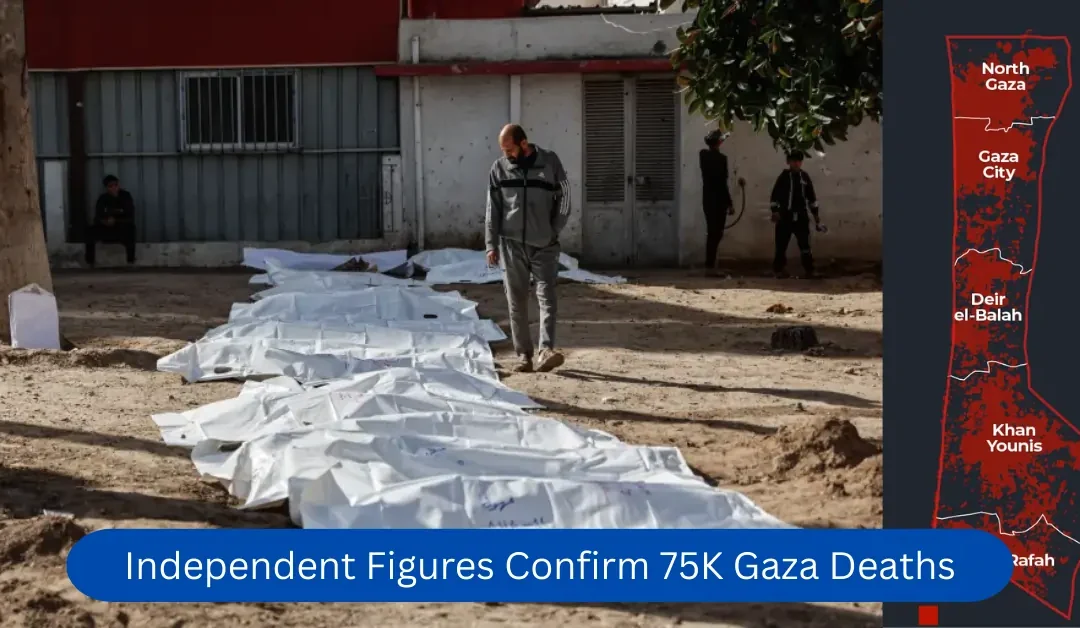
In the Latest News coming from global health researchers, new peer-reviewed studies have confirmed that the number of people killed in Gaza has crossed 75,000. These findings are now part of major Breaking News and Daily news highlights, as independent scientific reports say the real toll of the war is even higher than earlier official figures.
The new research suggests that the numbers reported by the Gaza Ministry of Health were not exaggerated. In fact, experts now believe those numbers may have been a minimum estimate — what they describe as a “floor” — meaning the true human cost could be even greater.
The updated data has been published in respected medical journals, including The Lancet and The Lancet Global Health, adding strong scientific backing to the findings.
What the New Research Reveals
One of the most important reports is based on the Gaza Mortality Survey (GMS). This large household study estimated that around 75,200 people died violently between October 7, 2023, and January 5, 2025.
Here are some key points from the study:
- The estimated death toll is nearly 35% higher than earlier official reports for the same period.
- The deaths represent about 3.4% of Gaza’s pre-war population of 2.2 million people.
- Women, children, and elderly people make up more than half — about 56% — of those killed.
The Gaza Ministry of Health had earlier reported around 49,000 violent deaths for the same timeframe. However, researchers now say those numbers were likely conservative due to the collapse of administrative systems during the conflict.
An Israeli army official reportedly acknowledged in January that around 70,000 people may have been killed during the war. This has added weight to the findings.
Why Official Numbers May Be Lower
Experts say counting deaths during war is extremely difficult, especially when hospitals, government offices, and record-keeping systems are damaged or destroyed.
The lead author of the study explained that:
- Many deaths go undocumented because families cannot report them.
- Thousands of bodies remain under rubble.
- Some victims are buried without official identification.
The research team interviewed 2,000 households, covering nearly 10,000 individuals. Unlike earlier statistical models, this study relied on direct interviews, making the data more grounded in real-life accounts.
A previous study in The Lancet had estimated around 64,000 deaths during the first nine months of the war using statistical methods. The new study extended the timeline and confirmed that the number has now exceeded 75,000.
Non-Violent Deaths and the Hidden Crisis
The research also highlights another serious issue — “non-violent excess deaths.”
These are deaths not caused directly by bombs or gunfire, but by:
- Lack of medical care
- Poor living conditions
- Shortage of food and clean water
- Collapse of hospitals
The study estimated around 16,300 non-violent deaths, including more than 8,500 excess deaths caused by worsening humanitarian conditions.
This creates what experts call a “grey zone” of mortality. For example:
- A person injured in a blast may die months later from infection because there is no surgery available.
- Someone with kidney failure may die due to lack of dialysis or clean water.
In such cases, it becomes harder to separate direct war deaths from indirect deaths caused by the collapse of basic services.
The Healthcare System in Collapse
Another major concern raised in the studies is the near destruction of Gaza’s healthcare system.
Before the conflict escalated, Gaza had 36 hospitals and more than 3,000 hospital beds. By May 2025:
- Only 12 hospitals were still able to provide more than emergency care.
- Around 2,000 beds remained available for the entire population.
- Reconstructive surgery capacity has almost disappeared.
The study published in eClinicalMedicine estimated that by April 2025, more than 116,000 people had suffered injuries during the war.
Between 29,000 and 46,000 of those injuries require complex reconstructive surgery.
Before the conflict, Gaza had only eight board-certified plastic and reconstructive surgeons for over 2 million people. Now, even that limited capacity has been severely reduced.
Experts say that even if hospitals return to their pre-war capacity, it could take at least 10 years to clear the backlog of surgeries.

Long-Term Impact on Survivors
The long-term impact of these injuries is deeply worrying.
More than 80% of injuries were caused by explosions, including air strikes and shelling in crowded urban areas. Many patients are suffering from:
- Severe burns
- Broken bones
- Crushed limbs
- Permanent disabilities
Without urgent treatment, survivors face risks of infection, sepsis, and lifelong disability. Tens of thousands may live with untreated conditions unless international medical support increases dramatically.
In late 2025, famine was declared in northern Gaza, further weakening injured survivors and making recovery even harder.
Calls for Accountability and Ceasefire
The authors of the studies have called for urgent action.
They stress that:
- Hospitals must be protected under international humanitarian law.
- Medical aid must be increased immediately.
- Civilian infrastructure should not be targeted.
Researchers warn that unless hostilities end, both the death toll and the number of complex injuries will continue to rise.
This issue has become central in global discussions around the Gaza conflict, the Israel-Hamas war, humanitarian crisis, ceasefire negotiations, and international law — all trending topics in current global conversations.


