
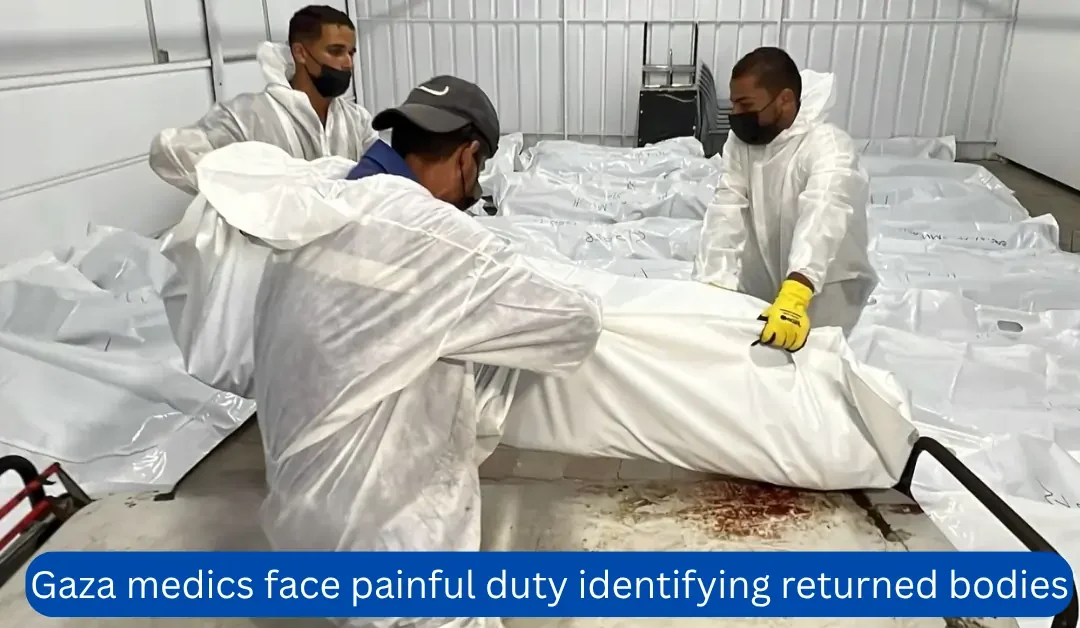
In the Latest News from Gaza, doctors are facing a heartbreaking task — identifying the bodies of Palestinians returned by Israel under a recent ceasefire deal with Hamas. Out of 120 bodies, only two have been identified so far, showing how difficult and painful the process has become for medical teams working with very few resources.
A Painful Mission for Gaza’s Doctors
At Nasser Hospital in Khan Younis, Dr. Ahmed Dhahir, head of forensic medicine, described the situation as “primitive and heartbreaking.”
- No information provided:
- The bodies arrived without names, records, or documents — only numbered tags from 1 to 120.
- Israel did not share any identifying data, which has made the work nearly impossible.
- Lack of medical tools:
- Gaza doctors do not have access to DNA testing labs or advanced scanning machines.
- They are using basic methods such as checking height, body shape, and visible injuries to try and recognise the victims.
- Few identified so far:
- After days of hard work, and with limited information from Israeli authorities, only two bodies have been successfully identified.
- “Their faces were unrecognisable,” said Dr. Dhahir. “It was the hardest thing I have ever done.”
The Ceasefire Exchange
The transfer of the bodies took place as part of a truce agreement between Israel and Hamas after nearly two years of war.
- Israel released around 2,000 Palestinian detainees in exchange for 20 Israeli hostages.
- The agreement also required Israel to return 15 bodies of detainees for each of the 28 Israeli hostages killed during the conflict.
- So far, Hamas has returned nine of those bodies, saying they need more time to find the rest.
Members of the Red Cross have been helping with these exchanges and were seen assisting in Khan Younis, where teams were digging in search of more missing remains.
Signs of Torture and Abuse
The Director General of Gaza’s Ministry of Health, Dr. Munir Al Barsh, said that many of the returned bodies showed signs of torture and severe burns.
- Inhumane treatment:
- “The detainees were bound like animals and blindfolded,” Dr. Al Barsh told reporters.
- He said this was proof of “serious human rights violations.”
- Call for investigation:
- Dr. Al Barsh demanded an international investigation and legal action against those responsible.
- He confirmed that the bodies had been stored in Israeli morgues and freezers for months, not exhumed from burial sites.
- Dehumanising process:
- Ismail Al Thawabta, director of Gaza’s Government Media Office, said some bodies “were tied by the neck, as if hanged.”
- He accused Israel of continuing “a cycle of dehumanisation and genocide” against the Palestinian people.
Families Searching for Loved Ones
Inside Nasser Hospital, families waited anxiously outside the morgue, hoping for any clue about their missing relatives. The Ministry of Health has now created an online portal to help families identify victims by viewing photos carefully selected by officials.
- If a body is not identified within five days, it will be buried by the Ministry of Religious Endowments, with every grave marked so families can locate it later.
Among those waiting was Akram Al Munasra, who finally identified one of his sons.
“Thank God, I found my son Abdullah,” he said, weeping. “He had been missing since October 7.”
He explained that Abdullah’s face was disfigured from torture, and he recognised him only by a small mole and the shape of his teeth.
“It was the worst moment of my life,” he said softly. “No father should have to see his child like that.”
His other son, Khaled, is still missing. “Abdullah was just a civilian near the border that day,” he added. “He wasn’t a fighter. Why was he killed like this?”
Global Reaction and Humanitarian Calls
This Breaking News has drawn strong responses from humanitarian groups around the world. Many are urging for an independent investigation into the deaths and the treatment of prisoners.
- Human rights concern:
- Organizations like Amnesty International and the UN have called for full transparency and accountability.
- International awareness:
- Social media platforms such as YouTube and X (formerly Twitter) are filled with stories shared by grieving families.
- Medical appeal:
- Gaza doctors are asking for international help, especially DNA testing kits and protective equipment, to identify the remaining bodies.
A Story of Pain and Persistence
As the Daily news highlights from Gaza continue to reveal new details, the story of these doctors and families reflects both human suffering and courage.
Despite limited tools, they keep working day and night to give names back to the dead — so their families can finally say goodbye.
This tragedy serves as a reminder that beyond politics and war, there are people — doctors, parents, and children — struggling to bring dignity to those who have been lost.


