
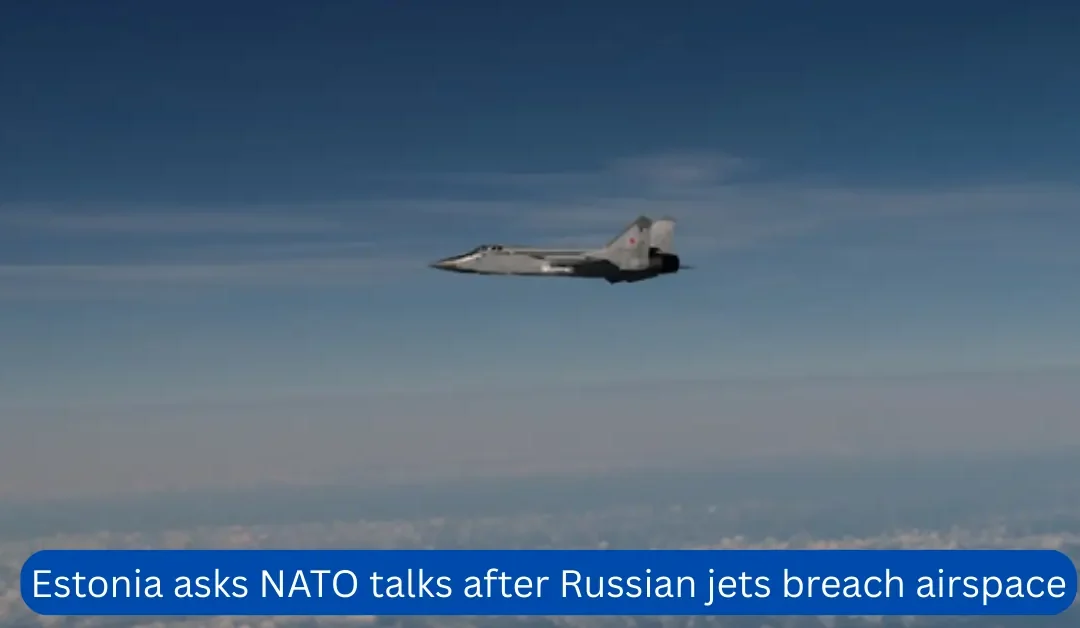
In the Latest News from Europe, Estonia has asked for urgent talks with other NATO members after Russian fighter jets entered its airspace on Friday. According to Estonian officials, three Russian MiG-31 warplanes flew over the Gulf of Finland and stayed in Estonia’s skies for 12 minutes without permission.
The incident has raised fresh concerns in Europe about rising Russia tensions, the safety of NATO’s eastern borders, and the wider impact of the Ukraine war.
1. What Exactly Happened?
Estonia said the Russian jets entered its skies from the northeast before they were forced out by NATO aircraft.
- No Permission: The jets had no official flight plans.
- Unsafe Flying: Their transponders were switched off, and they did not communicate with Estonian air traffic control.
- NATO Response: Finnish jets intercepted the planes first, and Italian F-35 jets, already based in Estonia, escorted them away.
This marks the fifth violation of Estonian airspace this year, according to government officials.
2. Nato’s Strong Response
Under Article 4 of the NATO treaty, any member state can call for urgent consultations when it feels threatened.
- Estonia’s Move: Prime Minister Kristen Michal said Estonia needs a strong, united response.
- Allies Involved: Italy, Finland, and Sweden scrambled jets as part of NATO’s air policing mission.
- Collective Defence: NATO reminded that any attack or provocation against one member could affect all 32 members.
In the words of one NATO spokesperson, this was “yet another example of reckless Russian behaviour and NATO’s ability to respond.”
3. Russia’s Denial and Justification
As expected, Moscow denied any wrongdoing.
- Russian Defence Ministry: Claimed the jets were on a “scheduled flight” and followed international air regulations.
- Baltic Waters Claim: Russia said the planes flew over neutral Baltic waters, more than 3 km from Estonian territory.
- Pattern of Denial: Similar denials were made earlier when Poland and Romania accused Russia of airspace violations.
Despite Russia’s explanation, many in Europe see these incidents as deliberate provocations linked to the ongoing military conflict in Ukraine.
4. Wider Pattern of Airspace Violations
Estonia is not the only country raising concerns. Recent weeks have seen a series of incidents across Eastern Europe.
- Poland: Earlier in September, Poland shot down three Russian drones and said at least 19 drones crossed its skies.
- Romania: Detected Russian drones near the Danube River during strikes on Ukrainian infrastructure.
- Belarus Factor: Belarus, a close Russian ally, claimed drones entered Poland “accidentally” due to navigation issues.
These repeated events have forced NATO to move more troops and fighter jets to strengthen its eastern flank.
5. Why It Matters for Global Security
This latest violation highlights a dangerous escalation in the region. It shows how the Ukraine war is spilling into neighboring countries and testing NATO’s unity.
- US Reaction: President Donald Trump commented, “I don’t love it. I don’t like when that happens. Could be big trouble.”
- Estonian PM’s Warning: Said Russia wants to distract NATO from Ukraine by forcing members to defend their own borders.
- Daily News Highlights: NATO members including the UK, France, Germany, and Denmark are already flying air defence missions over Poland.
These developments underline the risks of a bigger global security crisis if such incidents continue.
The Breaking News of Russian fighter jets entering Estonia’s airspace is not just about one country. It is part of a wider pattern of Russian aggression that directly affects NATO’s eastern members. With the Ukraine war still ongoing and Russia refusing to back down, the stakes for Europe and the world remain high.


