
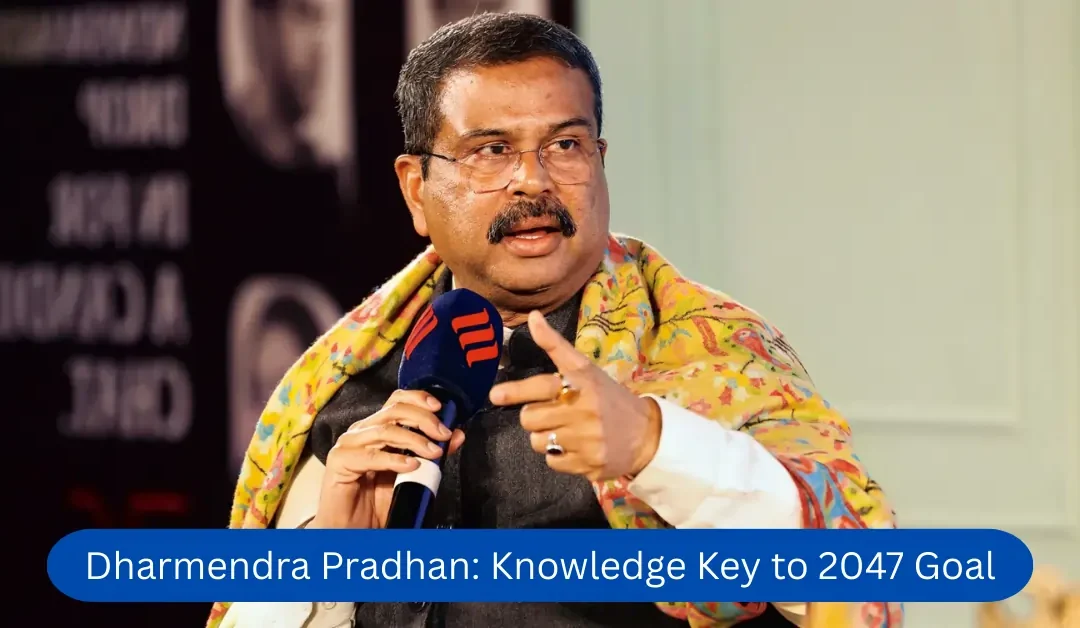
Union Education Minister Dharmendra Pradhan recently spoke at an interaction hosted by The Indian Express, where he shared his views on student politics, the future of education under the National Education Policy 2020, artificial intelligence, and India’s long-term development goals. In this detailed conversation, he explained how his childhood, political journey, and vision for education are shaping today’s reforms.
1. Growing Up in Odisha: Roots That Shaped His Thinking
Dharmendra Pradhan comes from Talcher in Odisha, a town known for coal mines and heavy industries. The region is close to rivers like Mahanadi and Brahmani. He shared how growing up in such an environment influenced his personality and political journey.
- His area produces a large amount of India’s coal, making it an industrial hub.
- He grew up seeing mines, power plants, and hardworking laborers.
- His family had a connection with India’s freedom movement.
He also spoke about the story of Baji Raut, a young boy from nearby Dhenkanal who was killed during the freedom struggle. Stories like these, along with his grandfather’s involvement in the independence movement, inspired him from a young age. He said this background made him sensitive to social issues and motivated him to join student politics.
He recently visited Kartavya Bhavan in Delhi, calling it a symbol of India moving forward and leaving behind a colonial mindset. According to him, the country is entering a new phase of development.
2. Student Politics and Changing Campus Culture
Pradhan began his political journey with the Akhil Bharatiya Vidyarthi Parishad (ABVP). Over the years, student politics has changed a lot. Many critics say student groups today influence campus decisions strongly.
When asked about this, he said:
- ABVP promotes the idea of “nation first.”
- Governance decisions follow formal democratic processes.
- Campuses should not become platforms for anti-national slogans.
He believes that today’s students live in a very different world compared to 30 years ago. With social media, AI, and instant information, opinions spread quickly. Because of this fast-changing environment, student movements also look different.
According to him, education institutions must protect freedom of expression but should not allow threats to national unity. This statement has sparked debate and is part of ongoing Breaking News discussions around campus politics in India.
3. NEP 2020 and the AI-Driven Future
One of the main topics of discussion was the National Education Policy (NEP) 2020. Although officially introduced in 2020, Pradhan said the planning began in 2014. The policy aims to modernize India’s education system after a gap of 34 years.
He explained that NEP 2020 is futuristic and technology-friendly. In today’s world, Artificial Intelligence (AI) is changing jobs, markets, and industries. The government believes AI can improve classrooms as well.
Some key points he highlighted:
- AI can help bridge learning gaps.
- A Centre of Excellence for AI in Education is being set up at IIT Madras.
- Technology can make education affordable and accessible.
He believes AI will not replace teachers but will support them. India is also hosting summits where experts, startups, and policymakers discuss how AI can improve learning outcomes. In the context of Latest News about AI’s impact on jobs, he says India must prepare its youth for future challenges.
4. Focus Beyond IITs: Strengthening Primary Education
Often, public discussion focuses only on elite institutions like IITs and IIMs. But Pradhan said education is interconnected — from preschool to research.
India has:
- Around 300 million learners
- About 250 million school students
- Nearly 10 million teachers
Under NEP, children now start formal learning at age three. Anganwadis are being integrated into the education system. The aim is to shift from rote learning to critical thinking and design thinking.
He stressed that if India wants to become a developed economy by 2047, it must invest in knowledge and research. According to him, building a strong foundation in early education is just as important as promoting higher research.
These reforms are regularly featured in Daily news highlights, especially as India prepares for long-term growth goals.

5. Language Debate: Mother Tongue vs English
Another major issue discussed was the language policy under NEP. The policy recommends that children should study in their mother tongue at least until Class 5.
Pradhan clarified:
- The government does not want to impose Hindi.
- Education should happen in Tamil in Tamil Nadu, Malayalam in Kerala, Odia in Odisha, and so on.
- English can be chosen as a second language.
He believes learning in the mother tongue improves understanding and critical thinking. From Class 1, students can learn a second language of their choice. From Class 6 onwards, they learn three languages.
He also pointed out that only around 15% of India’s youth are comfortable in English. Many developed countries like Germany, Japan, and China use their native languages for education and production. He argues that India should not feel inferior because of language.
To support his view, he mentioned historical examples like the Konark Temple, built centuries ago without English influence. According to him, India’s civilization and knowledge systems existed long before English became common.
6. Vision for 2047: Knowledge Economy
Pradhan repeatedly stressed one important message: if India wants to become a developed nation by 2047, it must focus on knowledge, research, and innovation.
His vision includes:
- Promoting startups and innovation missions.
- Strengthening research through the National Research Foundation.
- Encouraging critical thinking instead of rote memorization.
He believes education reform is not just about textbooks but about building a complete ecosystem — from early childhood learning to advanced scientific research.


