
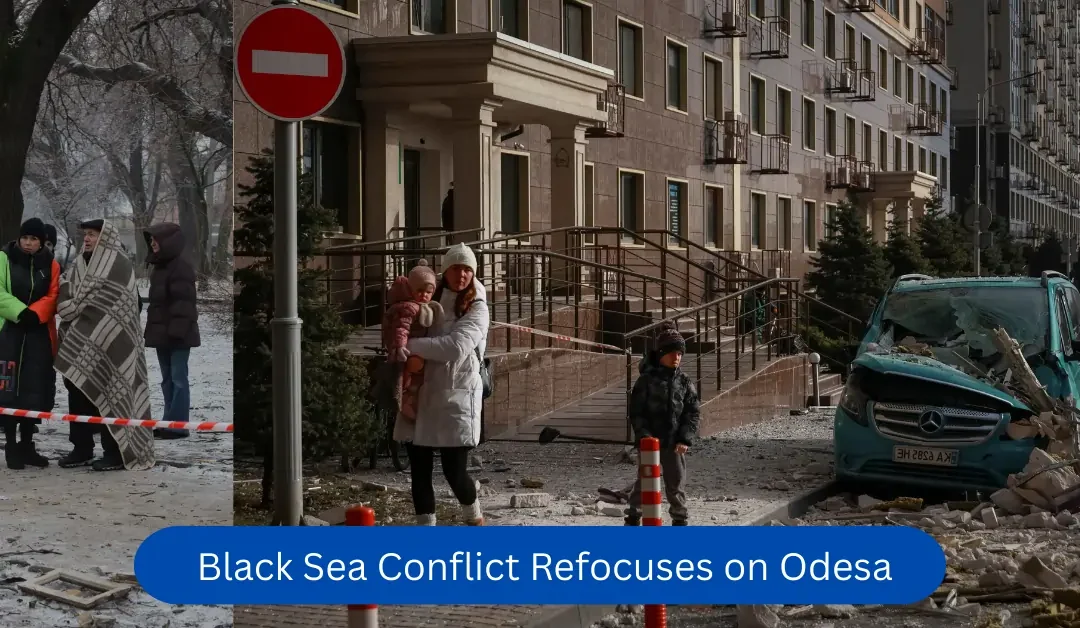
Ukraine’s Black Sea city of Odesa is once again facing intense pressure as Russia steps up long-range missile and drone attacks. Unable to reach Ukraine’s main port directly, Moscow is now striking from a distance, targeting homes, power systems, and key infrastructure. This escalation has made Odesa a central focus of the Latest News and Daily news highlights across the world.
For residents, the attacks are no longer rare events. They have become a regular part of life, especially during the harsh winter months, when electricity and heating are critical for survival.
Homes Damaged, Lives Shaken
Outside the Kadorr apartment complex, located close to the Odesa seafront, rescue workers and residents gather in freezing temperatures. A section of the building’s upper floors has been torn open after a Russian drone strike. Broken glass, concrete, and metal lie scattered on the ground below.
Several parked cars were crushed by falling debris. People stood silently, staring at the damage, trying to understand how close they came to losing their lives.
A Resident’s Fear
Anastasia, a 35-year-old woman living nearby, knows the pain of war too well. She had earlier fled eastern Ukraine after her hometown was occupied. Now, she fears history may be repeating itself.
She said she was asleep when the building suddenly shook. At first, she thought she was dreaming. Soon after, she heard the loud buzzing sound of another drone passing overhead.
“It used to feel safe here,” she explained. “Now it feels dangerous again. I don’t know if I should move, but I’m scared.”
Her feelings reflect those of many people in Odesa, as attacks have increased sharply in recent months.
Why Odesa Is Being Targeted
Odesa is Ukraine’s most important port city and a vital gateway to the Black Sea. While Russia has not been able to capture the city or block it by sea, it continues to view Odesa as strategically important.
Early in the war, Ukraine successfully pushed Russian warships away using naval missiles. Since then, Russia has shifted its strategy. Instead of approaching by sea, it is now attacking from afar using drones and missiles.
Key Reasons Behind the Attacks
- Odesa plays a major role in Ukraine’s economy
- The city handles most of Ukraine’s agricultural exports
- Cutting power and water weakens civilian morale
- Winter attacks increase pressure on the population
This strategy has turned the Black Sea region into a dangerous “grey zone,” where the fighting continues without direct naval battles.
Almost Daily Attacks on Energy Systems
The most severe attack in recent weeks took place in mid-December, when a massive wave of missiles and drones struck energy facilities across the region.
Impact of the December Strike
- Large areas lost electricity for days
- Water supply was interrupted
- Heating systems stopped working
- Thousands of families were left in freezing homes
Since then, attacks have become almost daily. There have been only a handful of days without explosions. The goal, officials say, is to exhaust the population and damage morale.
This ongoing assault has kept Odesa at the center of Breaking News updates.

The Black Sea: Protection and Weakness
The Black Sea offers both safety and risk. On one hand, it acts as a natural barrier, preventing ground forces from easily reaching the city. On the other hand, it makes air defence more difficult.
Unlike inland cities that have layered air defence systems, Odesa is more exposed. Drones and missiles launched from nearby occupied areas can reach the city quickly.
As a result, even with strong defence efforts, some attacks still break through, causing damage to civilian areas.
Psychological Pressure on Civilians
Military officials say the attacks are not only about physical damage. They are also designed to create fear and mental stress among civilians.
How the Pressure Is Applied
- Night-time drone attacks disturb sleep
- Repeated alarms create anxiety
- Social media is used to spread fear
- Civilian buildings are targeted
Every night, the sound of drones fills the sky. Families sleep in basements or hallways, unsure if their homes will still be standing by morning.
This constant stress has become part of everyday life, making it a major topic in Daily news highlights.
Schools and Public Buildings Hit
The damage is not limited to homes. Educational institutions and public buildings have also been struck.
At a construction and architecture school in central Odesa, staff members are working to clean up after multiple drone hits. Windows are shattered, walls are damaged, and the building has no heating.
A Painful Loss
The school’s director said one of the most painful losses was the destruction of their historical archive, which dated back decades. Important records and memories were lost forever.
He questioned why such a place would be targeted. His belief is simple: destroying education slows down Ukraine’s ability to rebuild after the war.
Why the Black Sea Matters So Much
Nearly 90% of Ukraine’s agricultural exports pass through ports in the Odesa region. These shipments are essential not just for Ukraine, but for global food supplies.
Because of the attacks:
- Shipping routes have become dangerous
- Insurance costs have risen
- Export volumes face disruption
The Black Sea feeds Ukraine’s economy, but it has also become one of its greatest vulnerabilities.
Preparing for the Worst
Despite the attacks, defence forces continue to prepare the city for any possible scenario. Anti-tank barriers, defensive zones, and emergency plans are being put in place.
Officials stress that the threat from land, sea, and air must all be taken seriously. Even if a full capture of Odesa seems unlikely, the danger has not passed.
Civilians Pay the Highest Price
While military targets remain out of reach, ordinary people are suffering the most. Families face long power cuts, freezing nights, and constant fear.
Odesa remains standing, but under pressure. As winter continues and attacks show no sign of stopping, the city has become a symbol of resilience — and a reminder of the human cost of war.


